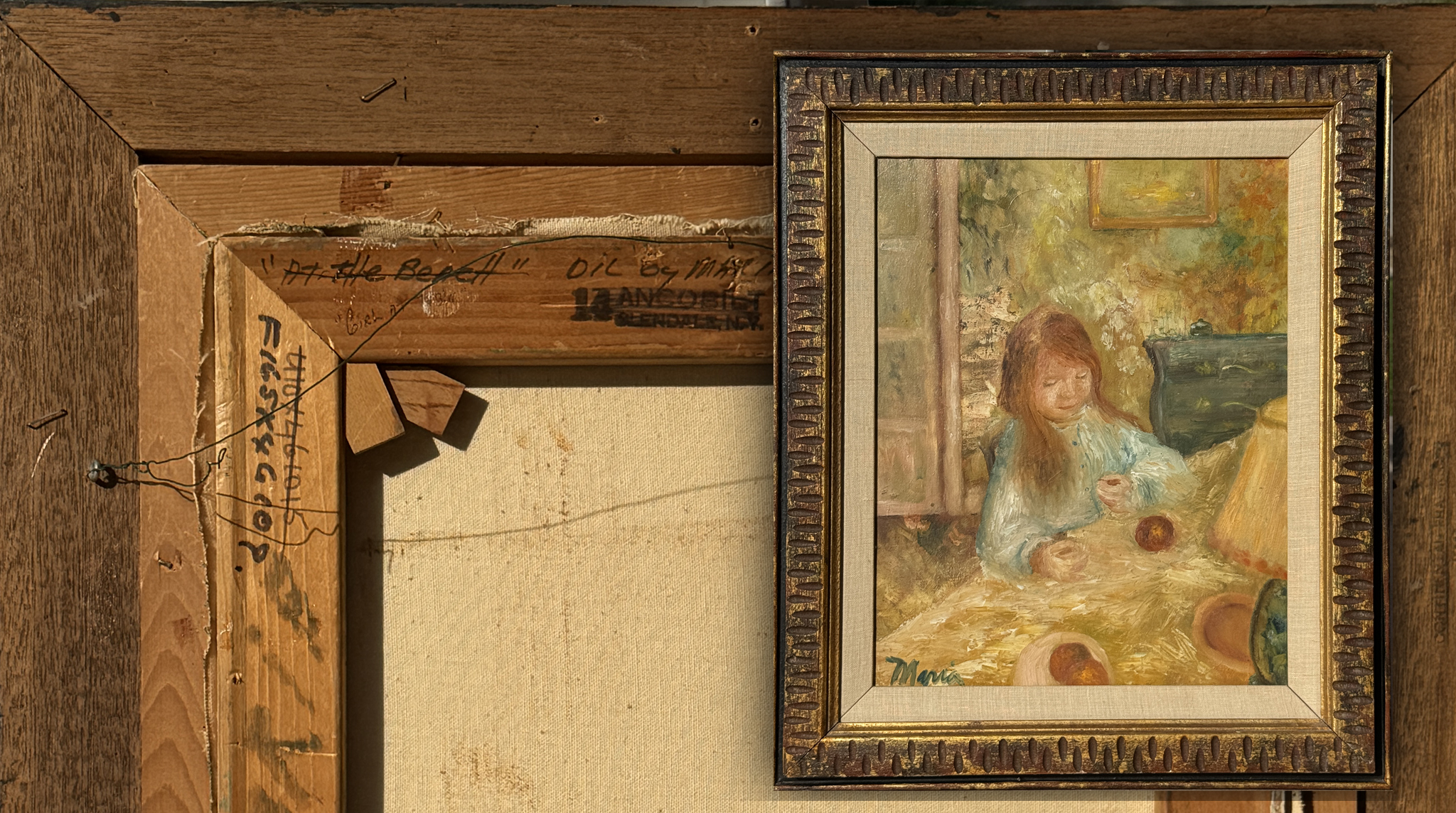
My sister asked me the other day how I know what I’m looking at when I find a painting. It’s a fair question, because from the outside it probably looks like guesswork. In reality it’s more like a long conversation with the object.
The first thing I notice, of course, is the front of the painting. Is it signed? Does it look like an original work, or one of those decorative copies that turn up everywhere? If I like it — and there are a thousand ways for a painting to be interesting — I start looking at how the artist is handling composition, color, line, and shape. Is the eye moving through the picture in an intentional way? Is there energy in the brushwork? Sometimes a painting can be technically proficient but still dull. Too sweet. Too sentimental. Those usually don’t come home with me.
If it passes that first test, I start looking at the practical clues. The hardware on the back tells you a lot. Modern copyists often use a very specific type of hanging hook — flat and D-shaped. When I see that, I pause. It doesn’t automatically mean the painting is new, but it raises the question. If the image itself feels familiar — say it looks like a Renoir-style scene — I’ll do a quick image search right there just to make sure it isn’t a known reproduction.
If the painting still feels promising, I take it home and examine it more carefully. That’s when the detective work really begins.
I photograph it and start studying the back. Are there gallery stamps, old labels, handwritten notes? How is the canvas attached to the stretcher? Staples usually mean modern; small tacks can suggest an earlier piece. The frame can give clues too. American frames tend to have mitered corners on the back, while many European frames show square joins.
Then I look closely at the surface of the painting itself. Does the paint have real texture? Are there signs of age, or areas that might need repair? Sometimes the title is written on the back, and the handwriting itself becomes another clue. Even the name of the painting can hint at when it was made or what the artist was thinking.
Eventually I search the signature and begin the long process of trying to identify the artist. That part can take hours — sometimes days — and often leads nowhere. But the process forces me to spend a long time really looking at the painting.
And that’s the best part. By the time I’m finished, I usually understand the piece much better than when I first picked it up. Sometimes I love it more. Sometimes I decide it’s not as strong as I thought.
But every painting has a story. Who made it? Why did they paint it? Who lived with it for years before it ended up where I found it?
Figuring that out is half the fun.
Leave a Reply