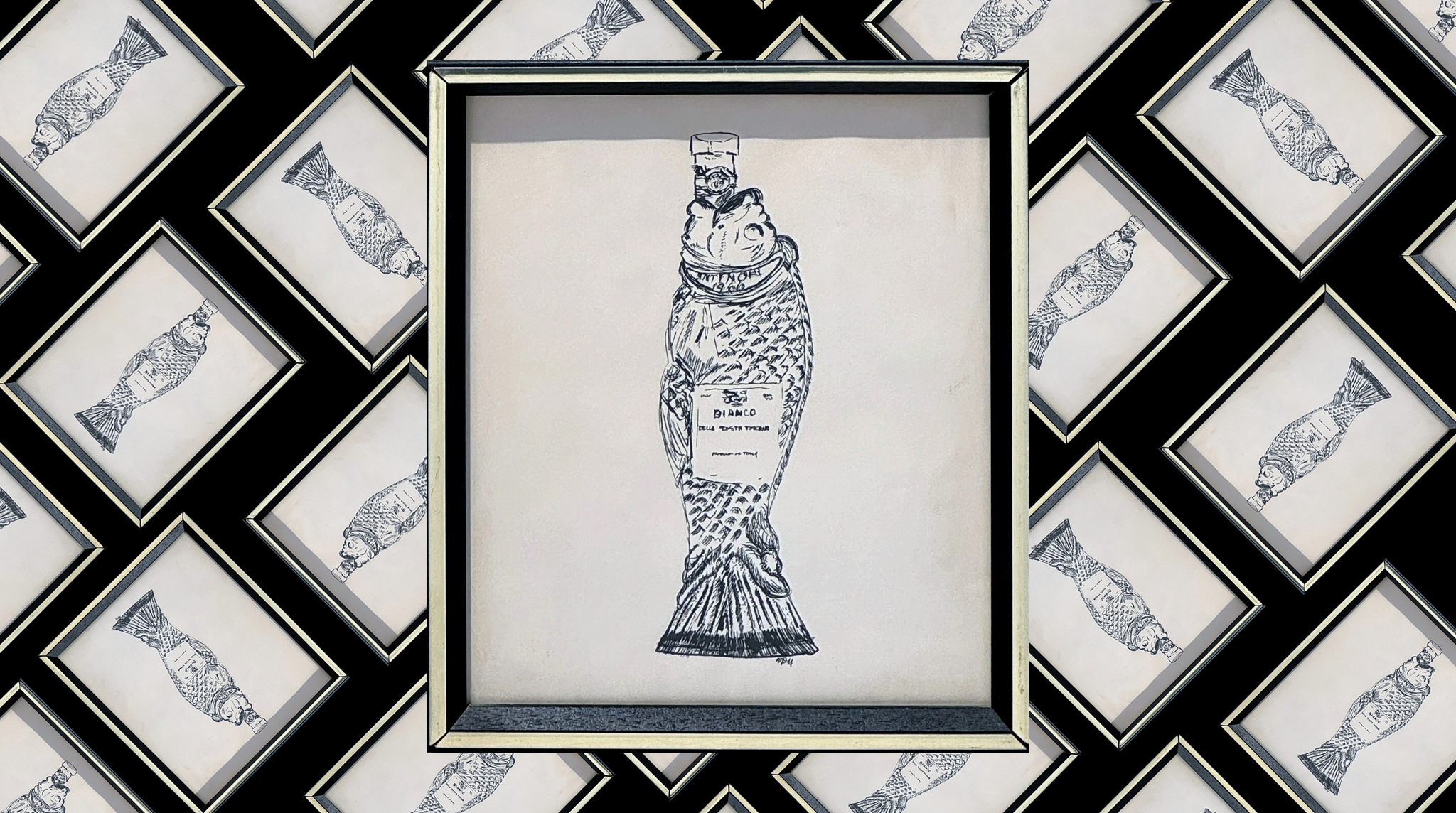
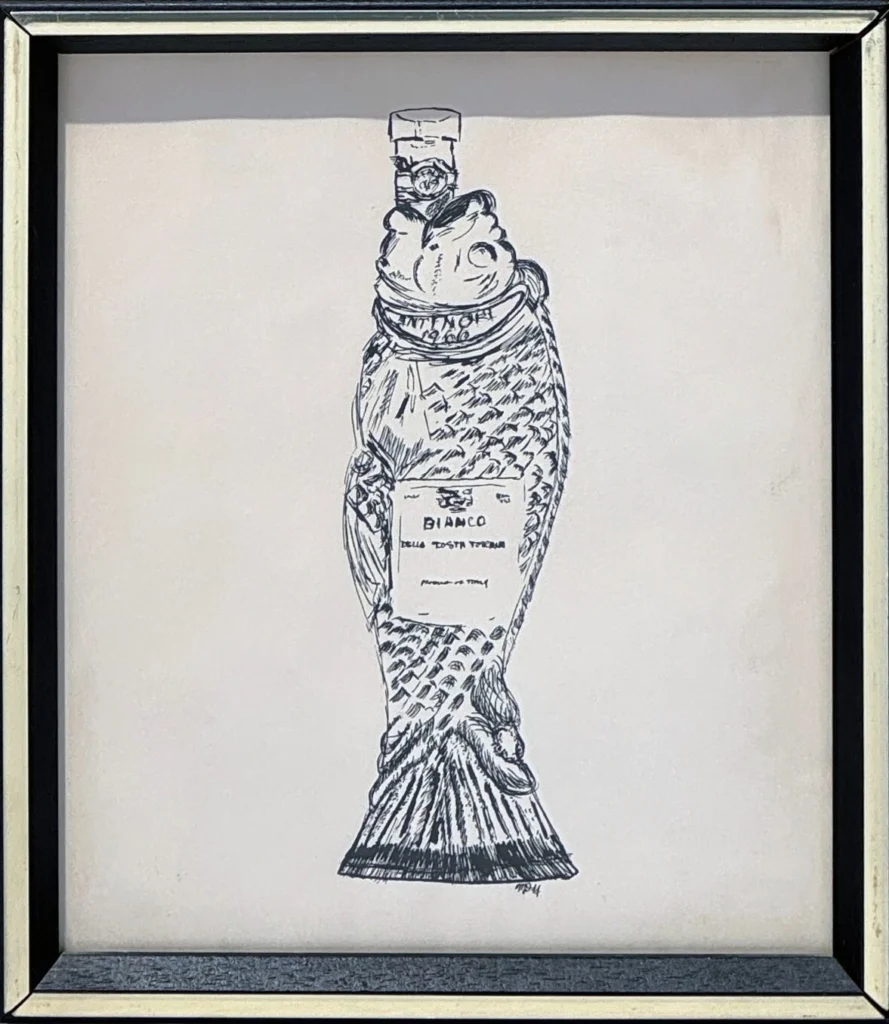
This mid-century pen and ink drawing delights me. It sits centered within its vintage black-and-silver Aaron Brothers frame and does very little. It’s stark, restrained, and oddly adorable all at once.
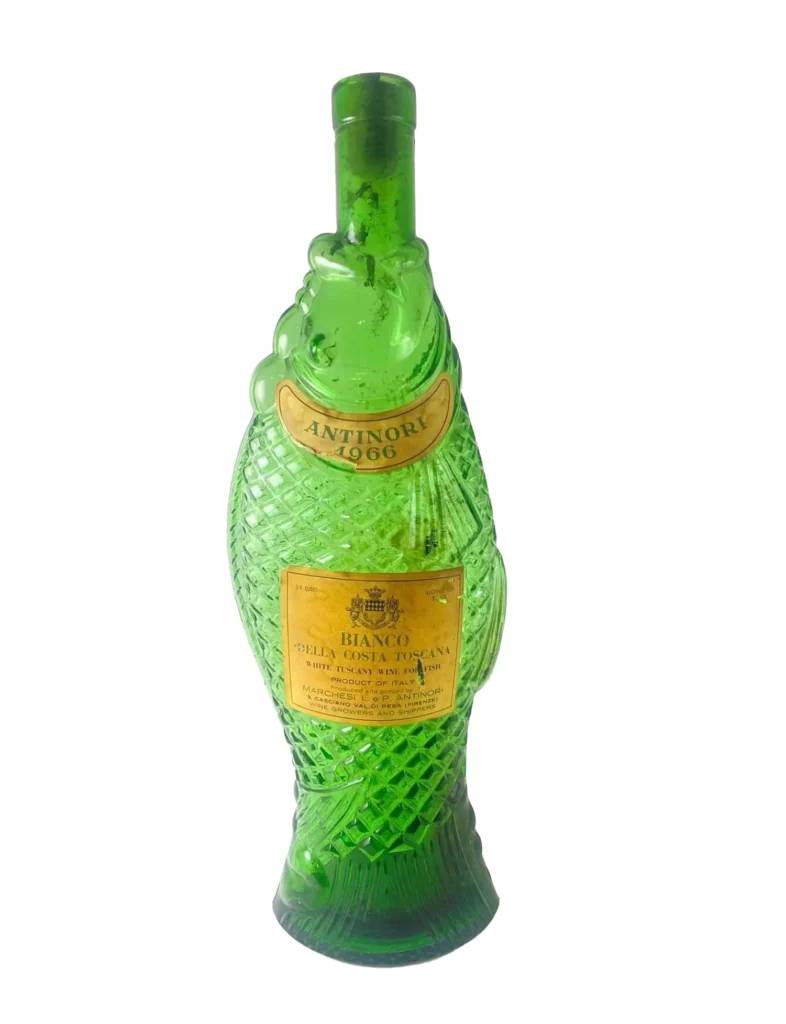
The subject is the 1966 Antinori Della Costa Toscana fish bottle, an object that once relied on the opposite strategy. The original bottle was bright green and glossy, all surface and personality, unapologetically playful even by the standards of 1960s Italy — a moment when all design including fashion, furniture, and automobiles embraced bold color, sculptural form and every kind of excess.
This drawing is that object’s inversion.
Where the bottle was vivid, this is black and white. Where the glass was shiny and tactile, the drawing is matte and flat, offering no highlights or shadows, only line. The ribbed surface of the bottle becomes pattern rather than texture. The label, once a piece of branding, collapses into a simple rectangle, into just another shape inside the form.
What I find most charming is the lack of irony. This isn’t parody or nostalgia. It feels as though someone took the time to translate a familiar, slightly kitschy object into something more enduring.
I imagine an artist with formal training — someone fluent in reduction, someone who sensed there was another dimension to this particular object. As if the drawing wasn’t about the bottle at all, but about what remained once surface was removed.
When people say they love mid-century modern today, they rarely mean the exuberant, color-saturated excess of 1960s Italy. They mean something flatter. Colder. Cleaner. Black and white. Reduced. The version of the era that emptied itself of decoration and held onto structure.
Seen this way, the drawing feels less like a preview than a quiet refusal. Made in the mid-1960s, at the height of color, gloss, and spectacle, it looks backward toward an earlier discipline — the graphic clarity and restraint that defined the mid-1950s before exuberance took over.
The bright green bottle belonged fully to its moment. The drawing stepped outside of it. A mass-produced object, translated in its own time into something deliberately out of step — and because of that, something that lasted.
And there is only one.
Leave a Reply